Is a JDM Car Tour in Tokyo Worth It? An Honest Look
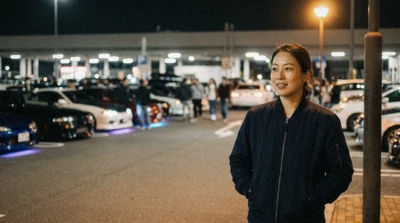
Is a JDM car tour in Tokyo worth it? For most car-curious travelers, yes, especially on a first trip with no rental car and no contact inside the meet scene. A guided night runs $82 to $156, gets you past a parking area with no pedestrian entrance, and puts you close enough to touch Skylines and RX-7s you would otherwise only see in photos. It is a weaker call for a confident solo traveler happy to freelance on trains and taxis, or anyone who has already done the Daikoku run once and just wants a quiet repeat visit. Below I break down what a night actually costs against doing it yourself, what you get for the money, and who should book versus skip. Compare every JDM car tour Tokyo option side by side before you decide.
Quick answer
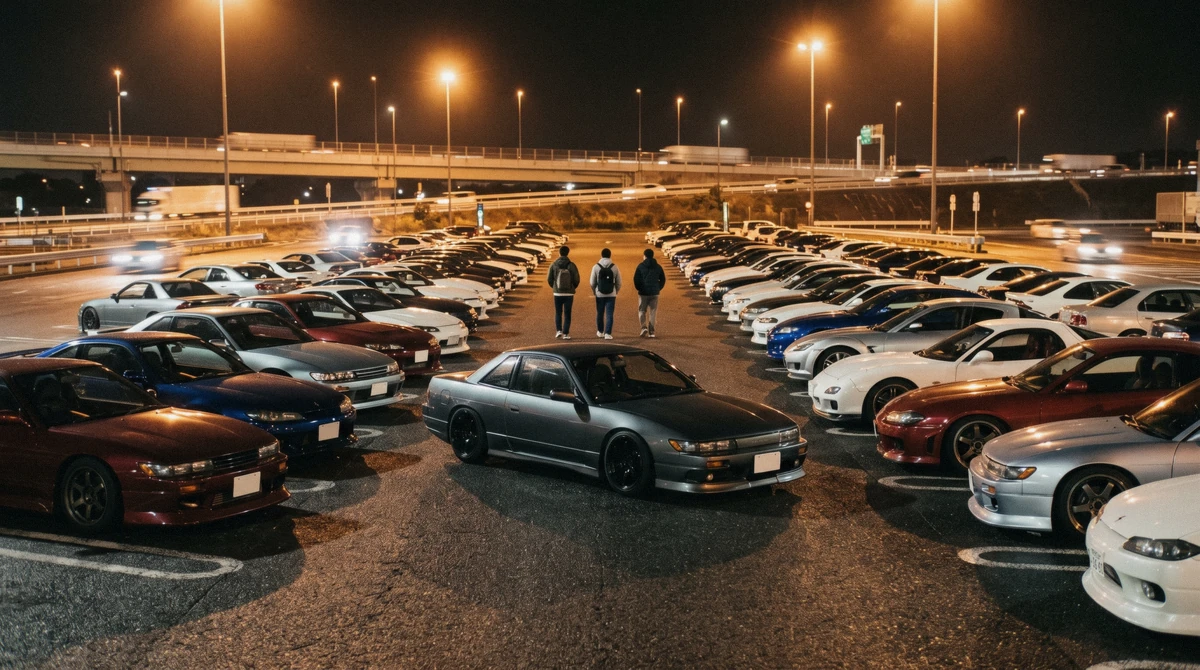
Yes, if you want guaranteed PA access, a route with multiple stops, and no need to freelance a taxi at midnight; the four tours run $82 to $156 per person as of August 2026. Skip it if you already have wheels and local knowledge of the meet nights, or if you only want a quiet solo look with no guide chatter.
Key takeaways
- Guided rides run $82 to $156 per person, all evening, 3 to 5 hours
- A solo taxi round trip to Daikoku alone can cost $133 to $173 before tolls, more than the cheapest tour
- The honest downside: meets are informal, no operator can promise a specific car
- Best for first-timers with no car and no local contact inside the scene
- Friday and Saturday nights deliver the fullest lots; weeknights can run quiet
- All four tours offer free cancellation, so book the one that fits and adjust later
The Short Answer
A JDM car tour in Tokyo earns its price when you weigh it against the alternative: standing at a highway parking area entrance with no legal way to walk in, no idea which night the lot will be full, and a last train that leaves before the meet even peaks. A guide solves the access problem and the timing problem in one booking. Here is our rule of thumb after riding every operator on this site.
- Worth it if: this is your first time chasing the Daikoku scene and you have no rental car
- Worth it if: you want more than one stop in a night, since Rainbow Bridge, A-PIT and Tokyo Tower are built into the route
- Worth it if: you are traveling solo or as a couple and the per-seat price beats a taxi split two ways
- Skip it if: you already own or can borrow a car and know the meet nights from experience
- Skip it if: your budget is capped under $50 for the night, since even the cheapest tour sits above that
- Skip it if: you specifically want to walk your own pace with zero guide narration
What It Actually Costs
Prices below are per person as of August 2026, pulled straight from the live listings. The last row is what a taxi-only DIY night to Daikoku actually costs, at a checked rate of roughly ¥150 to the dollar.
| Option | Typical price | Duration | Best for |
|---|---|---|---|
| Neon Nights | from $82 | 4 to 5 hours | Best value, a full 50 minutes at Daikoku |
| Legendary JDM Underground Meetup | from $100 | 4 hours | First-timers wanting a broad route |
| Daikoku Nights | from $107 | 3 to 4 hours | Choosing your own ride for the night, plus a Tatsumi stop |
| Fast & Furious Night Drive | from $156 | 4 hours | Premium cars and full expressway runs |
| On your own, taxi both ways | $133-173 round trip (¥150/USD, August 2026) | one Daikoku stop only | Confident night owners who don't mind the fare |
A guided night lands between $82 and $156 all-in, for pickup, guaranteed PA access, and a route built around several stops. A solo taxi run to Daikoku costs roughly ¥10,000-13,000 (about $67-87) each way before tolls, so the round trip can cost more than our cheapest tour and gets you exactly one parking area for one night, no A-PIT stop, no guide introductions, and no fallback if the gate closes early. I go deeper on the value math in the cheapest JDM car tour in Tokyo, and readers chasing the premium end of the lineup should also look at our take on the Fast & Furious night drive.
What You Get for the Money
A typical night starts with pickup or a meeting point in Shibuya, either the Dogenzaka side streets or right outside Tower Records, somewhere between 7 and 9pm depending on the tour. From there we cross the Rainbow Bridge, the suspension bridge over Tokyo Bay that shows up in half the photos anyone takes on these tours, city lights on one side and the bay on the other.
- Pickup in Shibuya, near Dogenzaka or Tower Records, early evening
- A crossing of the Rainbow Bridge with the bay and skyline lit up on both sides
- A stop at A-PIT Autobacs Shinonome, the tuning megastore where builds sit parked in the lot as much as inside
- Time at Daikoku PA on the Bayshore Route, or Tatsumi PA if the guide reroutes there instead
- A photo stop near Tokyo Tower on the way back into the city
Once we are on site, the point is proximity, not a windshield view. You walk the rows, guides introduce you to owners who are usually happy to talk about their builds, and you get close enough to photograph the details a highway drive-by never shows: aero kits, exhaust setups, the interiors builders actually live with. What is included in the price is the vehicle, the guide, and every stop on the route.
What is not included is food, drinks, or anything you buy from a vendor if one happens to be parked nearby that night.
A typical night, roughly
So you can weigh the price against your own patience, this is the rough shape of an evening on any of the four tours, times shifted a little depending on which one you book:
- 7:00 to 9:00pm, pickup or meeting point in Shibuya, either Dogenzaka side streets or right outside Tower Records
- First 30 to 45 minutes, the drive out crossing the Rainbow Bridge, the bay and skyline lit up on both sides
- A stop at A-PIT Autobacs Shinonome, walking the lot and the shop floor before the parking-area portion of the night
- The core of the night, roughly an hour to 90 minutes on site at Daikoku or Tatsumi PA, walking the rows and talking with owners through the guide
- The return leg, usually with a photo stop near Tokyo Tower, back in central Tokyo by around midnight to 1am
None of this is exclusive access in the sense of a private event; the meets themselves are open to anyone who can physically get there. What the price buys is a vehicle that can get there, a driver who knows the route and the rules, and a guide who can walk up to a stranger's R34 and start a conversation you would not know how to start yourself.
The Honest Downsides
This is the part most tour pages skip, so here is what actually trips people up.
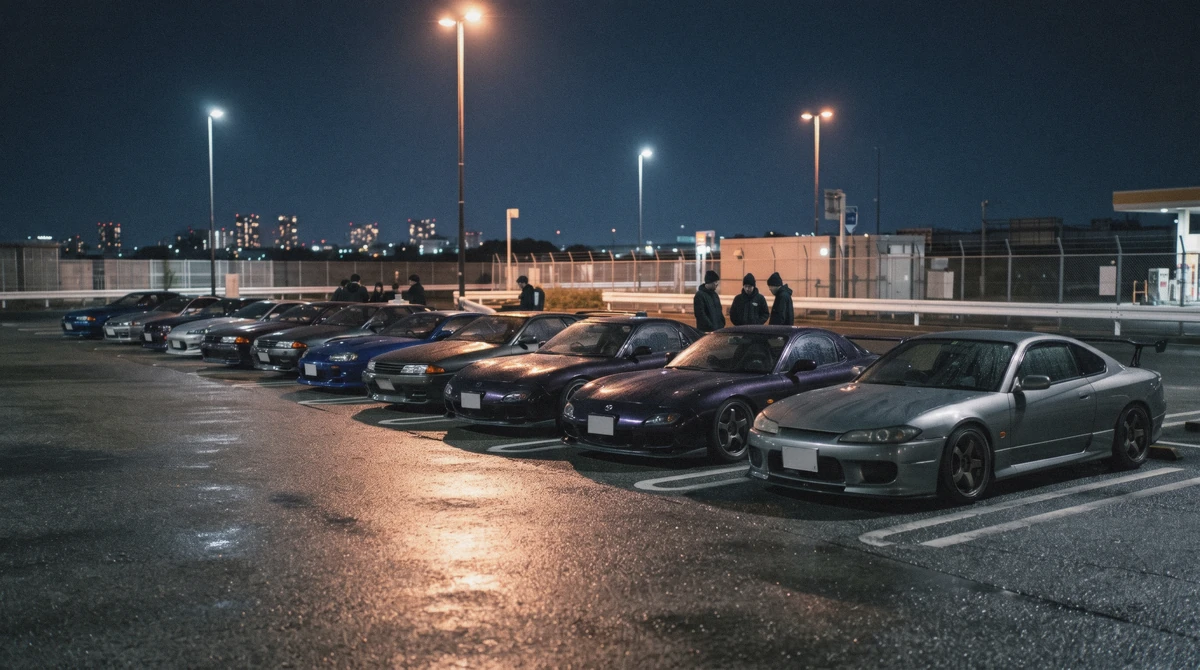
- Meets are informal with no schedule and no lineup. No operator, including the ones on this site, can promise a specific car will be there
- Weeknights can run quiet. The scene genuinely peaks Friday and Saturday; a Tuesday visit might mean a half-empty lot
- You ride, you do not drive. Every tour here is a passenger experience in a tuned JDM car, a performance van, or a sports sedan
- It is an outdoor experience in a parking area, not a showroom. Expect wind, exhaust fumes, and standing on asphalt for most of the visit
- Weather and season aside, the one real cancellation risk is a closed lot, covered below
None of these are dealbreakers for most travelers, but they are worth knowing before you book rather than discovering on site. A reader who wants a guaranteed itinerary with a guaranteed car list should look elsewhere; that product does not exist for this scene, on this site or anywhere else honest about it. What every tour here can promise instead is the route, the vehicle, and a guide who has done this enough times to read a quiet night and adjust the stops accordingly.
For an honest, tiered rundown of what actually shows up on a given night, see what cars you'll see at a Tokyo car meet.
On a weekend that gets too crowded, police periodically close Daikoku PA outright. A guided tour reroutes to Tatsumi PA or another parking area down the Bayshore Route and the night continues. On your own, that closure simply ends your night.
When It's Worth It Most
There is no real season to plan around here; the scene runs year-round and the weekly rhythm matters far more than the month. Friday and Saturday nights, roughly 10pm to 1am, are when the lots fill and the widest range of cars show up. A weeknight tour still runs and still crosses the Rainbow Bridge and stops at A-PIT, but the parking area itself can be noticeably thinner, sometimes just a handful of regulars. If your dates are flexible, weight them toward the weekend. If they are not, a Tuesday tour is still worth it for the route and the guide's knowledge; just set expectations that the meet portion will be quieter.
Summer humidity and winter cold both change the standing-around comfort of the visit more than they change what shows up. An August night means light layers and staying hydrated between stops; a January night rewards a proper coat, since you spend real time outside the vehicle at the PA itself rather than in climate control.
Tour vs Going Car-Spotting on Your Own
The short version: daytime spotting in Tokyo is genuinely DIY-friendly, but the night PA scene is not, because Daikoku sits on the Bayshore Route with no pedestrian entrance. Anyone with a rail pass can spend a free or near-free afternoon at showroom displays and parts warehouses, and that half of the hobby needs no tour, no booking, and no guide. It is specifically the parking-area meet, the part most people picture when they imagine a Tokyo car night, that a tour reaches and a solo visitor on foot or by train cannot.
If you want the full honest breakdown of what you can reach on your own, when it makes sense to skip the tour, and when it doesn't, I wrote a separate guide to JDM car spotting in Tokyo without a tour that walks through both halves in detail.
Who Should Do It, and Who Should Skip It
If you are a first-timer with no car and no local contact in the scene
book any of the four tours; the guide solves both the access and the timing problem
If you are traveling solo or as a couple on a tight budget
the Neon Nights ride is the cheapest per-seat option and still delivers a full 50 minutes on site
If you already have a rental car and know the Daikoku Friday-Saturday rhythm
skip the tour and drive yourself; see our DIY breakdown
If you want the widest fleet and a full expressway run
book Fast & Furious Night Drive, the premium option in the lineup
If your only free night is a Tuesday or Wednesday
book anyway for the route, but expect a thinner lot than a weekend visit
How to Book Without Overpaying
Book 2 to 3 days ahead where possible; weekend departures are the ones that fill first, and prices on all four tours here have stayed stable rather than surging closer to the date, so there is no real early-bird discount to chase, just availability. Every listed tour offers free cancellation at booking, which matters more than it sounds: Tokyo weather and jet lag both change plans, and a refundable slot means you are not out $100 if your evening falls apart. If your trip has a spare Friday and a spare Saturday, book the earlier date and hold the second as a weather or jet-lag backup rather than booking both.
- Best for first-timers on a budget: Neon Nights, from $82, a full 50 minutes at Daikoku
- Best for a broader night out: Legendary JDM Underground Meetup, from $100, Rainbow Bridge plus Tokyo Tower
- Best for the full premium experience: Fast & Furious Night Drive, from $156, expressway runs in higher-end cars
Traveling as a small group changes the calculation slightly. Each seat is booked and priced individually rather than per vehicle, so a group of three or four does not unlock a bulk discount the way a private car rental might, but it does mean everyone sees the same route and the same PA at the same time, which matters if the point of the trip is sharing the experience rather than splitting a fare. Solo travelers lose nothing by booking alone; the per-seat price is the per-seat price whether the vehicle carries one guest or four.
If you want to weigh all the options against each other one more time before booking, go compare every guided ride we track for Tokyo's JDM scene.
Frequently Asked Questions
Do you get to drive the car on a JDM car tour in Tokyo?
No. Every tour on this site is a passenger experience in a tuned JDM car, a performance van, or a sports sedan, with the guide or a driving partner behind the wheel. If driving yourself matters to you, this is not that experience.
Is a JDM car tour in Tokyo worth it if you're traveling solo?
Usually yes. Per-seat pricing on a tour beats a solo taxi round trip to Daikoku, which can run $133 to $173 before tolls and only reaches one parking area for one night with no fallback route.
What happens if a JDM tour gets rerouted because of a closure?
Police occasionally close Daikoku PA on overcrowded weekend nights. Guided tours reroute to Tatsumi PA or another parking area on the Bayshore Route, so the night continues instead of simply ending.
How far ahead should you book a JDM car tour in Tokyo?
Two to three days ahead is enough for most dates, though Friday and Saturday nights fill first. Prices stay stable rather than rising closer to the date, so book once your evenings are set.
Is a JDM car tour in Tokyo worth it compared to doing it yourself?
It depends on the half of the experience you mean. Daytime spotting at showrooms and parts stores is genuinely DIY-friendly; the night PA scene is not, since Daikoku has no pedestrian entrance. See our full DIY breakdown for the honest split.
What's actually included in the tour price?
The vehicle, the guide, and every stop on the listed route, typically Rainbow Bridge, A-PIT Autobacs, the parking-area meet, and a Tokyo Tower photo stop. Food, drinks, and any vendor purchases at the meet are on you.
Can you see the exact cars you want on a JDM car tour in Tokyo?
Never guaranteed. The meets are informal with no lineup and no schedule, so any operator promising a specific model is overselling. What a tour guarantees is access and a route; the exact cars parked that night are always a matter of luck.
Is one tour better for photographers than the others?
Any of the four works, since all include time standing among the parked cars rather than a drive-by. The longer stops, Neon Nights' 50 minutes at Daikoku and Daikoku Nights' combined Autobacs-and-Tatsumi route, give a photographer the most unhurried time per stop.